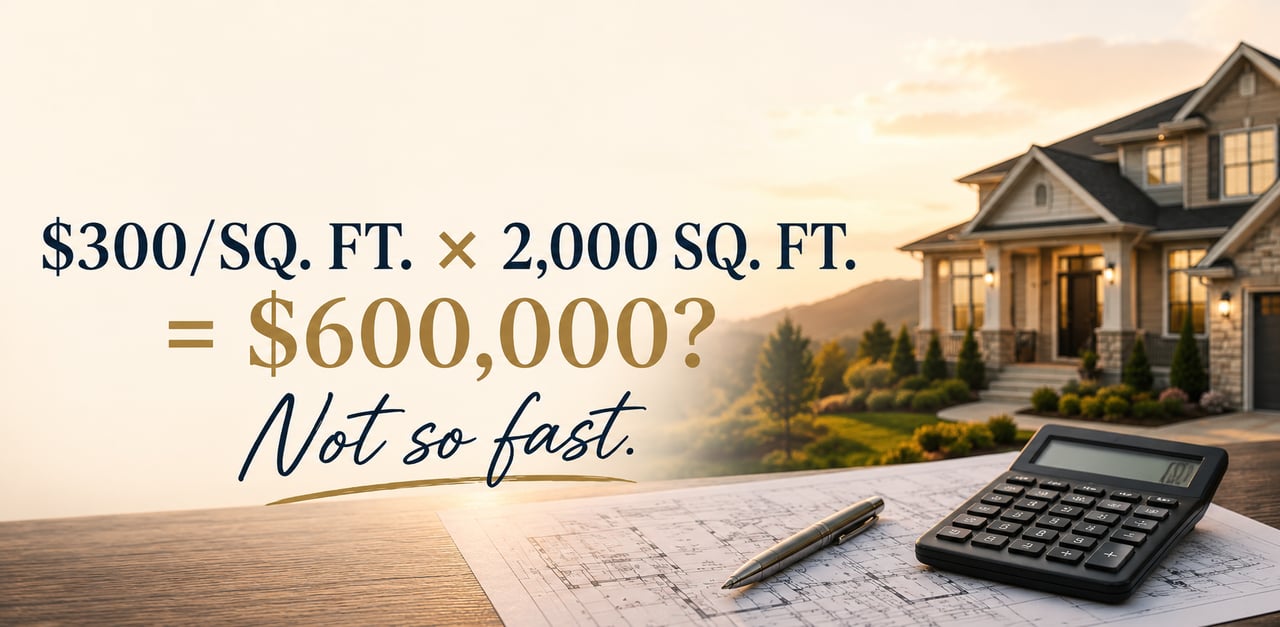
Can I Use Price Per Square Foot to Determine What My Eagle, Idaho Home Is Worth?
eagle agent Elizabeth Hume August 26, 2026
eagle agent Elizabeth Hume August 26, 2026
“The house down the street sold for $300 a square foot, so shouldn't mine be worth $300 a square foot too?”
I hear versions of this question all the time.
And I understand why. Price per square foot gives us a wonderfully simple calculation. Find a comparable home, figure out what it sold for per square foot, multiply that number by the square footage of your home, and—voilà—we have a value.
Except real estate doesn't work quite that neatly.
A home is more than sticks, windows, paint and square footage.
Two homes can be nearly identical in size and have very different values. To understand why, we have to look at the whole property.
If your neighbor's home sold for $300 per square foot, I absolutely want to know about it.
But then I want to know more.
Did they remodel the kitchen?
Do they have newer flooring?
Granite or other upgraded countertops?
How many bedrooms and bathrooms do they have?
Is their floor plan more functional?
Do they have a pantry?
Have the roof and HVAC systems been updated?
What condition was the home in when it sold?
Those details can influence how buyers perceive value.
Even the way square footage is arranged matters. Two homes may both contain 2,500 square feet, but one may have an open, functional layout while the other has space buyers find difficult to use.
Same number of square feet. Different experience living in them.
We often talk about “location” as though it only means the city or neighborhood.
It can get much more specific than that.
Two homes in the same Eagle neighborhood can have very different surroundings.
One may back to a busy road such as Eagle Road. Another may sit farther inside the neighborhood.
One may be on a cul-de-sac.
One may have more traffic passing the property.
One may be easier to get in and out of.
Another may have a water or mountain view.
Even when the homes themselves are similar, buyers may not value those locations equally.
Years ago, I was looking at lots in a fairly typical starter-home neighborhood. The homes hadn't even been built yet.
One lot had an east-facing backyard, which meant it wouldn't take the brunt of the afternoon sun. It also had a better opportunity for a mountain view.
That lot was priced approximately $10,000 higher than a lot facing the other direction.
Think about that.
There wasn't a kitchen.
There wasn't a bathroom.
There wasn't flooring.
There wasn't even a house yet.
And the lots already had different values.
Once houses are built and owners begin adding landscaping, patios, garages, shops, finishes and improvements, the differences become even greater.
That's one reason multiplying square footage by a single number can miss so much of the story.
This is another problem with relying too heavily on price per square foot.
Some of the features a buyer may value aren't necessarily included in the home's reported living area.
An oversized garage can matter.
An RV garage can matter.
A shop can matter.
Outbuildings can matter.
Outdoor living areas, landscaping, views and the lot itself can matter.
A buyer comparing two similarly sized Eagle homes may be willing to pay considerably more for the property that has the features that fit the way they want to live.
Yet dividing the sales price by the home's living square footage doesn't explain any of that.
There's another side to this conversation.
Homeowners understandably look at what they've spent improving a property when thinking about value.
But cost and market value aren't necessarily the same thing.
I once saw a home where the owner had invested around $200,000 in improvements.
That's substantial.
The challenge was that the finishes reflected a very specific, older style—including things such as crystal knobs—rather than what many buyers in that market were currently looking for.
The homeowner had absolutely spent the money.
But spending $200,000 doesn't automatically mean buyers will value the home $200,000 more.
That's why, when I'm evaluating improvements, I'm interested in more than what they cost.
I want to know:
What did you improve?
How well was it done?
How old is it now?
And importantly:
How much value are today's buyers likely to place on it?
Those can be very different questions.
No.
I think of it as a napkin test.
It's quick.
It's easy.
And it can give us some perspective.
If you're looking at a large neighborhood built around the same time by the same builder, with similar floor plans, lots, condition, finishes and amenities, price per square foot may give us a useful starting point.
It can also help identify something worth investigating.
If several seemingly comparable homes are selling within a similar range and one is dramatically different, I want to know why.
But that's the point:
I want to know why.
Price per square foot can help us ask the question. It shouldn't automatically be the answer.
When I'm preparing a market analysis, I'm trying to compare the entire property—not just its size.
That includes things such as:
And even then, we're developing an informed opinion and a pricing strategy.
Ultimately, the market still gets a vote.
If you're wondering what your Eagle, Idaho home is worth, looking at the price per square foot of nearby sales isn't a bad place to begin.
Just don't stop there.
The house across the street may have the same square footage and a completely different lot.
The house next door may have the same floor plan and a remodeled kitchen.
The home around the corner may have an RV garage, mountain view or quieter location.
Those differences are part of what buyers are evaluating when they decide what they're willing to pay.
And that's why determining the value of a home requires looking at the whole picture, not simply multiplying two numbers.
If you're thinking about selling a home in Eagle, I'm happy to look at the property, review the relevant market data and talk through the features that may affect its value.
Sometimes price per square foot gives us a place to start.
Then we need to look at the house.
Elizabeth Hume
Associate Broker | Eagle & Treasure Valley, Idaho
Stay up to date on the latest real estate trends.
best real estate agent
From preparing your home to agent compensation, carrying costs and moving, selling a home involves more than the expenses you see at closing.

best real estate agent
Local knowledge and relationships can be valuable—but “local” doesn't automatically mean “best.”
best real estate agent
Before you remodel, replace or spend $10,000 getting your home ready to sell, figure out what today's buyers will actually notice—and value.
eagle agent
Price per square foot can be a useful starting point—but your home is more than a math equation.
Experience luxury real estate guided by over 20 years of expertise, strategic insight, and unwavering integrity. Every transaction is handled with personalized attention, skilled advocacy, and a commitment to achieving your goals.
Elizabeth Hume
[email protected]
208.860.5451
License #AB30910
2025 E Riverside Dr Ste 260 Eagle, ID 83616